
Precision you can build on. NABL accredited laboratory
calibration@kesartesting.com+91 63579 03105

Weight & Mass Calibration Services in India

As part of its mechanical calibration expertise, Kesar Testing Service LLP provides accurate and dependable mass calibration services.

Mass — Kesar Testing Service LLP

THE SERVICE

Mass & weight calibration in Ahmedabad, by an NABL accredited lab.

Mass calibration compares your standard weights and weight boxes with higher-accuracy reference weights to establish their conventional mass and error. These weights are what you use to check your balances every day, so if they are wrong, every routine balance check built on them is wrong too.

By doing regulated comparison with approved standards, mass calibration guarantees the precision of weights and weighing devices.

Mass calibration by The Kesar Testing Service LLP

As part of its mechanical calibration expertise, Kesar Testing Service LLP provides accurate and dependable mass calibration services. In accordance with international standards like OIML, NABL, and ISO, we guarantee the accuracy of laboratory balances, industrial scales, and standard weights by using certified reference weights and sophisticated calibration techniques.

We perform the Mass calibration of:

1.Digital balances with capacities of up to 400 kg are calibrated to fulfill the high accuracy standards of laboratory and industrial environments.

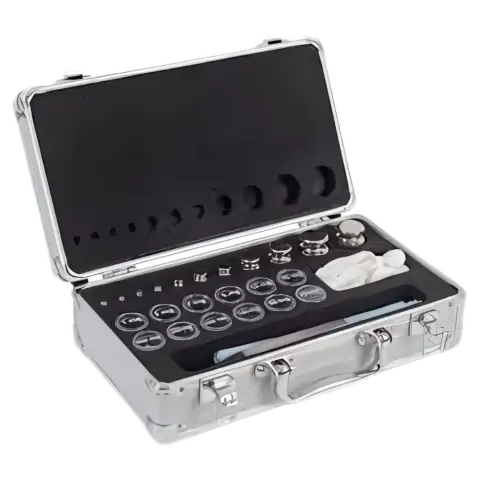
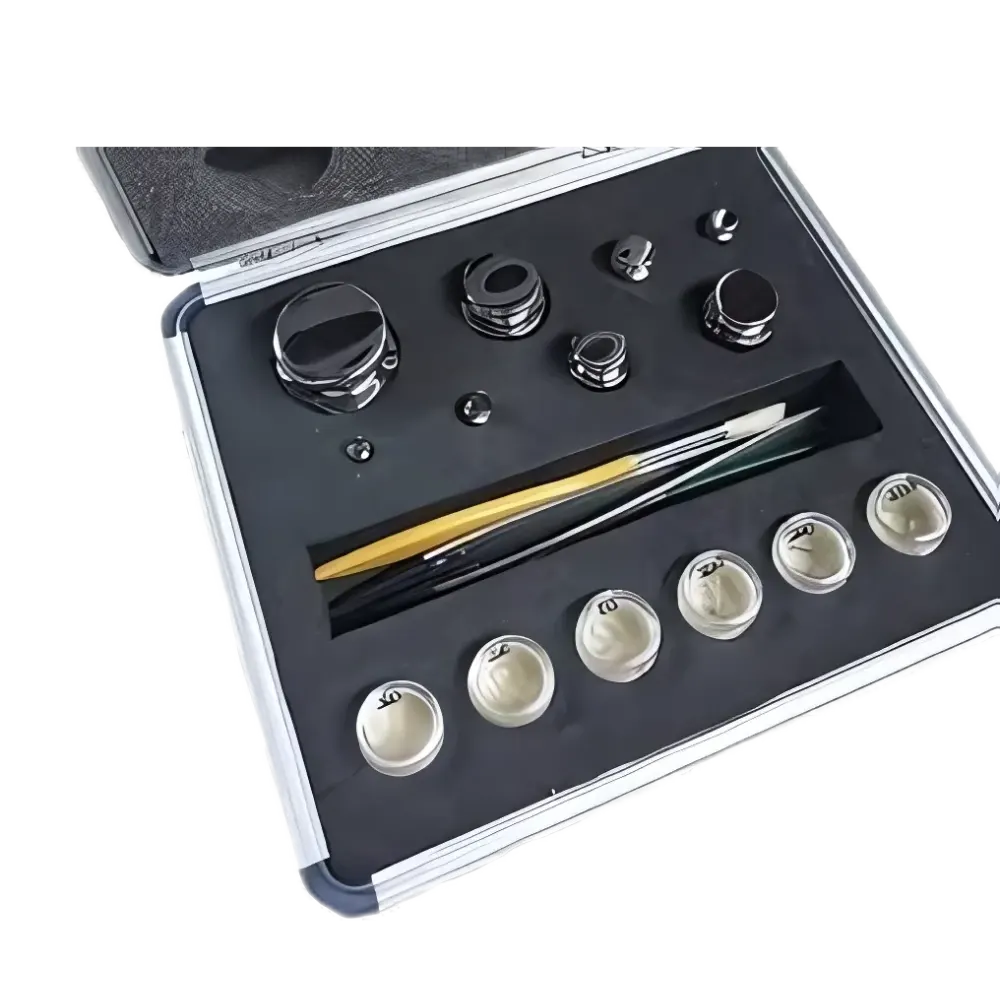
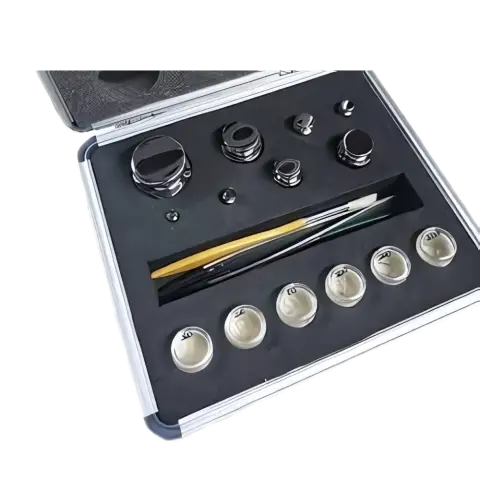
2.Analytical weight boxes are available in stainless steel (SS), brass, and cast iron, with weights ranging from 1 mg to 20 kg (classes F1 to E2). High-precision mass comparators are used for calibration.

All calibrations are performed in a controlled environment using recognized reference standards, assuring complete traceability and adherence to OIML, NABL, and ISO norms.

For precise and trustworthy mass calibration, Kesar Testing Service LLP uses high-precision E2 and F1 class standard weights. These weights guarantee the maximum degree of measurement accuracy because they can be linked to both national and international standards. Our expert staff services labs, manufacturing facilities, and industrial installations by offering both on-site and in-house calibration services. We assist our clients in achieving compliance, enhancing quality control, and guaranteeing consistent performance of their weighing devices by practicing strict calibration procedures and utilizing verified reference standards.

Feel free to contact us for reliable, expert calibration and validation services.

Thermal Calibration

Mechanical Calibration

Electrotechnical Calibration

Acoustic Calibration

Optical(LUX/VV) Calibration

calibration.kesar@gmail.com
Mass — photo 1Mass — photo 2

What we calibrate

  • Analytical standard weights
  • Weight boxes and weight sets
  • Stainless steel weights
  • Brass weights
  • Cast iron weights
  • Check weights for daily balance verification
  • Digital balances and weighing scales

What you receive

  • Certificate with conventional mass, error and uncertainty for each weight
  • Statement of the OIML R 111 class assessed, where requested
  • Traceability statement to national mass standards via NPL India
  • Identification of each weight as reported on the certificate

WHY IT MATTERS

Why mass & weight calibration matters
for Gujarat's industries.

Accurate, traceable calibration protects product quality and keeps your records defensible.

01

Trustworthy daily checks

Calibrated check weights make your routine balance verifications meaningful, giving QC and production a reliable basis for weighing decisions.

02

Class-appropriate weights

Knowing the actual error of each weight lets you confirm it is suitable for the balance and tolerance it is used to check.

03

Controlled conditions

Weights are compared under controlled environmental conditions in our Ahmedabad laboratory, reducing the influence of temperature and air currents on results.

HOW WE WORK

How our Ahmedabad lab works with you.

Every engagement follows the same disciplined steps, so results are consistent and audit-ready.

  1. 01

    Scope your requirement

    Share your instrument list, rooms or systems and the standards you work to. We confirm parameters, ranges and acceptance criteria before anything is scheduled.

  2. 02

    Plan the work

    We agree dates, on-site or in-lab handling and the protocol to follow, so production and QA know exactly what will happen and when.

  3. 03

    Measure with traceable standards

    Qualified engineers carry out the work using calibrated reference instruments traceable to national standards, recording raw data as they go.

  4. 04

    Report and certify

    You receive clear certificates and reports — results, uncertainty or acceptance criteria, and traceability — ready for audits and regulatory inspections.

FREQUENTLY ASKED

Mass & weight calibration in Ahmedabad: your questions.

Can’t find what you need? Call +91 63579 03105 or email calibration@kesartesting.com.

What is the difference between mass calibration and balance calibration?

Mass calibration determines the actual mass of a weight by comparison with a more accurate reference weight. Balance calibration uses calibrated weights to check how accurately a balance reads. The two depend on each other: a balance calibration is only as reliable as the weights used to perform it.

Which weight classes can you calibrate?

Weights are classified under OIML R 111 into classes such as E2, F1, F2 and M1, each with its own maximum permissible error. We calibrate laboratory and industrial weights using higher-class reference weights. Contact us with your weight classes and nominal values to confirm they fall within our NABL scope of accreditation.

Should check weights be sent to the laboratory or calibrated on-site?

Higher-accuracy weights are best calibrated in a laboratory, where temperature, humidity and air movement are controlled. Our Ahmedabad laboratory provides these conditions. For larger industrial weights or where removal is impractical, contact us to discuss whether on-site calibration is suitable.

How should standard weights be handled between calibrations?

Handle weights with tweezers or gloves rather than bare hands, store them in their case and keep them clean and dry. Fingerprints, dust and corrosion all change a weight's mass. Careful handling protects the value stated on the certificate until the next calibration.

LET'S WORK TOGETHER

Your calibration partner
in Ahmedabad, Gujarat.

Talk to our team about calibration, validation and testing for your facility.

Start a conversation